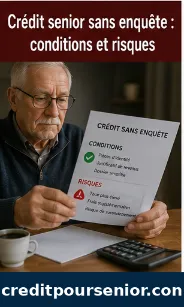
A no-check loan, meaning credit granted without consulting the registers or assessing whether you can repay, does not exist among authorised lenders in France. The Consumer Code obliges every lender to consult the FICP, the national register of repayment incidents on personal loans kept by the Banque de France, before granting consumer credit, and to assess your ability to repay on the basis of sufficient information.
People searching for this kind of offer are often already listed, turned down by their bank or embarrassed to show difficult statements. Fraudsters know it: adverts on social media, fake websites copying well-known banks, calls from so-called brokers. Older people, more often alone when these approaches arrive, are among the favourite victims, and expatriates are targeted in English as well as French.
What an authorised lender must always check
Consulting the FICP is systematic for any consumer credit, including microcredit and revolving credit. The lender must also gather information on your income and outgoings and, above certain amounts, obtain supporting documents. An FICP listing does not legally prohibit credit, but in practice it nearly always leads to a refusal.
How long a listing lasts
A recorded payment incident stays on the register for five years at most, and disappears as soon as the debt is fully repaid. An over-indebtedness plan triggers a listing for its duration, up to seven years. A personal recovery order is listed for five years. Checking your own position with the Banque de France is free and should be the first step before any application.
Warning signs of a fake loan offer
The table sets the typical promises made by fraudsters against the rules that apply to authorised lenders.
| What the advert promises | What the rules say | What to do |
|---|---|---|
| Loan with no register check | FICP consultation is compulsory for all consumer credit | Treat the offer as fraudulent |
| Arrangement fees payable before release | An intermediary may receive nothing before funds are paid out | Never pay in advance |
| Very low rate for a listed borrower | Rates are capped by usury law, but high risks are refused | Compare with the APR of real offers |
| Contact via messaging app or social network | The lender must provide a written offer and a pre-contract information sheet | Insist on the full offer |
| Company name close to a well-known bank | Authorised firms appear on the official register | Check authorisation and blacklists |
A real-world pattern: the insurance-fee scam
Bernard, 71, listed after an unpaid overdraft, answers an advert promising €15,000 with no checks. A so-called adviser sends him a contract bearing the logo of a real bank, then asks for €450 in insurance fees, followed by €780 in notary fees. Bernard pays €1,230. No loan ever arrives, and the copies of his identity card are later used to open fraudulent accounts.
Mistakes that turn a refusal into a loss
Sending an identity document, bank details and proof of address to a stranger is enough to enable identity theft. Before sending anything, check that the company exists, its authorisation number and its contact details on the regulator's official website. Fraudsters often copy the names and logos of genuine institutions, including British and Swiss banks with no French lending business.
Paying by voucher, foreign transfer or cryptocurrency
No genuine lender asks for payment by prepaid voucher, cash transfer or bank transfer to a foreign account. Those methods are chosen precisely because the money cannot be recovered. If you have paid, alert your bank at once, report it to the police and flag the scam on the official public reporting platform.
Trusting a private lender met online
Fake loans between individuals account for a large share of credit scams. A private person may lend occasionally, but someone who regularly offers loans to strangers is illegally carrying on an activity reserved for authorised institutions.
Lying about your situation to get past the checks
Hiding a loan or inflating your income with a real lender exposes you to having the whole debt called in early and, if documents are forged, to prosecution. An honest file that is refused at least leaves the door open to supported microcredit.
Lawful alternatives when the bank says no
A pawn loan from the Crédit Municipal, the public pawnbroker, is based on the value of an item you deposit, with no income test. It suits a one-off emergency and can be renewed by paying the interest. The item is returned when you repay; otherwise it is sold and any surplus goes back to you.
Microcredit with personal support
Personal microcredit finances €300 to €8,000 for people excluded from mainstream credit. Caisse d'Épargne Normandie, which offers it through its Parcours Confiance scheme, explicitly includes retirees among its target groups and works with more than 200 partners, including CCAS offices and Udaf family associations. The FICP is still consulted, but the assessment focuses on your budget and your project.
Policy advances and social help
Holders of an assurance-vie policy can ask their insurer for an advance with no income assessment. Pension funds, CCAS offices and charities make one-off grants that do not have to be repaid. A Point conseil budget, the free budget-advice service, helps sort through the options.
For a retiree on the register, the lasting way out usually lies in settling the incident that caused the listing. A payment plan agreed with the creditor, followed by full repayment, leads to removal from the FICP at the request of the institution that reported you. After a few months without incident, a bank will usually look at a new application on normal terms.
Six checks before trusting any lender
- Note the company's exact name, address and registration number.
- Look it up on the ACPR's register of authorised financial firms.
- Check that any broker or intermediary is registered with ORIAS.
- Consult the blacklists published by the authorities for credit and investments.
- Refuse any payment before the funds have reached your account.
- Insist on a written offer showing the APR, total cost and 14-day cooling-off period.
Questions about loans with no checks
Is a loan with no supporting documents legal? For small amounts some lenders ask for few documents, but they always consult the FICP and assess your ability to repay.
How do I find out whether I am listed? Ask the Banque de France, free of charge, online or at a branch, with an identity document.
I paid fees to a fake lender. What now? Contact your bank to try to recall the transfer, file a police report and report the scam. Change your passwords and watch your accounts closely.
Can a broker get me a loan without the bank checking the register? No. The broker passes on the file, but it is the lender that consults the FICP and decides. An intermediary who promises otherwise, or asks to be paid before funds are released, is breaking the rules.
Does the Crédit Municipal check my situation for a pawn loan? It checks your identity and address, but the amount depends on the valuation of the item, not on your income.
Organisations and offers to contact
- AMF, blacklists and warnings : The French markets regulator's blacklists of unauthorised websites, with links to the ABE Info Service lists covering fraudulent credit and insurance offers.
- Caisse d'Épargne Normandie, personal microcredit : Microcredit of €300 to €8,000 over 3 to 72 months, open to retirees among others, with tailored follow-up from Parcours Confiance and social partners.